
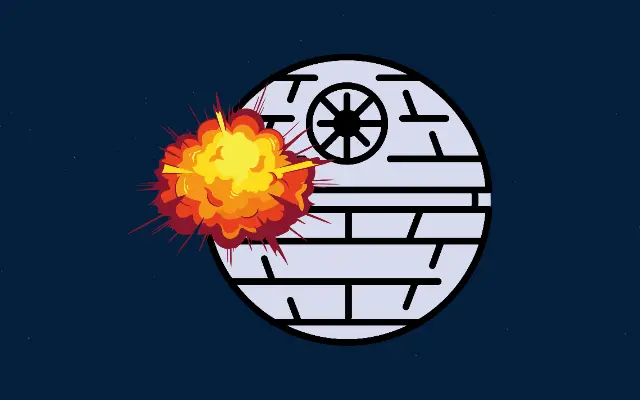
Most Zero Trust talks open with a framework diagram. Ours opened with the Death Star.
At DIGIT Expo, FullProxy’s Pat Gillan and Zscaler’s Mike Culshaw treated the Empire’s most famous loss as a cyber incident and ran it through a post-incident review. It’s a story most of the room already knew by heart. It also turns out to be a near-perfect case study in what goes wrong when security depends on a perimeter, implicit trust and a hope that nobody finds the gap.
Why perimeter security failed the Empire
Legacy architecture isn’t built for the AI age. It’s too complex, too static and too fragmented to respond at the speed modern attacks move.
The Empire had the biggest, most expensive perimeter in the galaxy. It still wasn’t enough.
1. Insider risk: the breach that started inside
The first failure happened long before any fighter launched. The weakness was designed in by a trusted engineer with full access and a very different agenda.
Your perimeter can’t stop someone who’s already inside it.
If trust is granted once, at the door, everything that follows depends on that single decision being right.
2. Data loss: the plans walk out
Next, the plans left the building. Sensitive data was stored, accessed and taken, and nothing meaningful noticed until it was far too late.
Data loss rarely looks dramatic in the moment. It looks like a legitimate session doing something slightly unusual. That’s why inspection and visibility matter as much as access control.
3. Identity can be spoofed
Then came the stolen shuttle and an outdated clearance code that still got waved through. A valid-looking credential was treated as proof of identity, with no check on the device, the context or whether the request made sense.
Swap the shuttle for a phished login or a hijacked session token, and you have one of today’s most common attack paths.
4. Lateral movement: once you’re in, you’re in
Once aboard, the intruders moved freely. They disabled systems, found what they needed and walked back out. The station’s design assumed anyone inside belonged there.
That’s lateral movement, and a flat network makes it easy. It’s the same flaw we see with traditional remote access, where one login hands over far more than the user needs. We cover this in more depth in VPN vs ZTNA: Time to retire the tunnel?
5. Machine speed and one exposed weakness
The final run came down to speed and a single exposed point, reachable from outside. Attackers don’t need a hundred ways in. They need one.
This is where AI changes the maths. Attacks now run at machine speed, with exploits completed in minutes. A human-paced response to an exposed weakness is already too slow.
This is where AI changes the maths. Attacks now run at machine speed, with exploits completed in minutes. A human-paced response to an exposed weakness is already too slow.
The post-incident review: how Zero Trust changes the outcome
So what would have saved the station? The talk boiled it down to three Zero Trust principles.
- Never trust by default. Always verify. Limit access to only what’s needed, and assume the breach is already underway. The insider, the spoofed identity and the free roaming all relied on trust that was never re-checked.
- Hide yourself from the internet. No exposed IP addresses. If it’s not reachable, it’s not breachable. With Zscaler Private Access (ZPA), users connect to a specific application through the Zero Trust Exchange, never to the network, so there’s no exposed weak point to aim at.
- Allow the good, prevent the bad, and protect the busy. Zscaler Internet Access (ZIA) inspects internet and SaaS traffic wherever users work. Security that gets in people’s way gets worked around, so the goal is protection users barely notice.
Three Zero Trust takeaways
- Attacks now move at machine speed. Exploits can be completed in minutes, so your defences can’t rely on someone spotting the problem in time.
- Treat insider risk the same as outsider risk. Being “inside” should never be a reason to trust a user, device or connection.
- Yesterday’s architecture is no longer fit for purpose in the age of AI. Bolting more onto the perimeter won’t close the gap.
Why this matters now for the UK public sector
For public sector organisations, this isn’t just an architecture debate. NCSC guidance already treats Zero Trust principles as the baseline for secure access, and GovAssure is raising the bar on what “good” looks like. The UK Government Cyber Action Plan is also putting investment behind public sector cyber resilience.
That creates both the pressure and the opportunity to act. The same logic applies to large enterprises in regulated sectors such as financial services, transport and retail.
Limit access to only what’s needed, and assume the breach is already underway. The insider, the spoofed identity and the free roaming all relied on trust that was never re-checked.
Zero Trust for the real world, with FullProxy and Zscaler
We’re security and infrastructure people ourselves, so we know the hard part isn’t understanding Zero Trust. It’s getting from a perimeter-dependent estate to working, least-privilege access without disrupting the services your users rely on.
That’s what we do. As an accredited Zscaler partner, FullProxy designs, deploys and manages ZPA and ZIA through our Zscaler Managed Service:
- Zero Trust roadmaps built around your applications, users and constraints
- Policy design and migration support, phased so services keep running
- Embedded expertise and managed services, proven in complex UK public sector environments
- Ongoing optimisation and monitoring, so policy keeps pace with your organisation
Missed the talk, or want to know where you stand? Get in touch and we’ll benchmark your current access model and help you pick a practical first use case. Or download Your next steps to Zero Trust to share with your team.
Zero Trust: FAQ
What is Zero Trust?
Zero Trust is a security strategy built on “never trust, always verify” and least-privilege access. Every request is checked against identity, device health and context, regardless of where it comes from.
How does Zero Trust reduce insider risk?
It removes the idea that being inside the network makes someone trustworthy. Each user gets access only to the applications they need, and that access is reassessed continuously, which limits what any one account can reach or take.
What is lateral movement, and how does Zero Trust stop it?
Lateral movement is when an attacker uses one compromised account or device to move across a network. Zero Trust connects users to specific applications rather than the network, so there’s no open path to move along.
What does “if it’s not reachable, it’s not breachable” mean?
With an inside-out architecture such as Zscaler Private Access, applications have no exposed IP addresses or open inbound ports. Attackers can’t target what they can’t find on the internet.
Why does AI make Zero Trust more urgent?
AI lets attackers find and exploit weaknesses at machine speed, sometimes in minutes. Defences that rely on people spotting a problem in time can’t keep up, so reducing the attack surface and limiting access matters more than ever.
Do I need to replace everything to adopt Zero Trust?
No. Most organisations start with one focused use case, such as third-party access, and expand in phases while existing systems keep running.